
Corem Has Two Income Statements
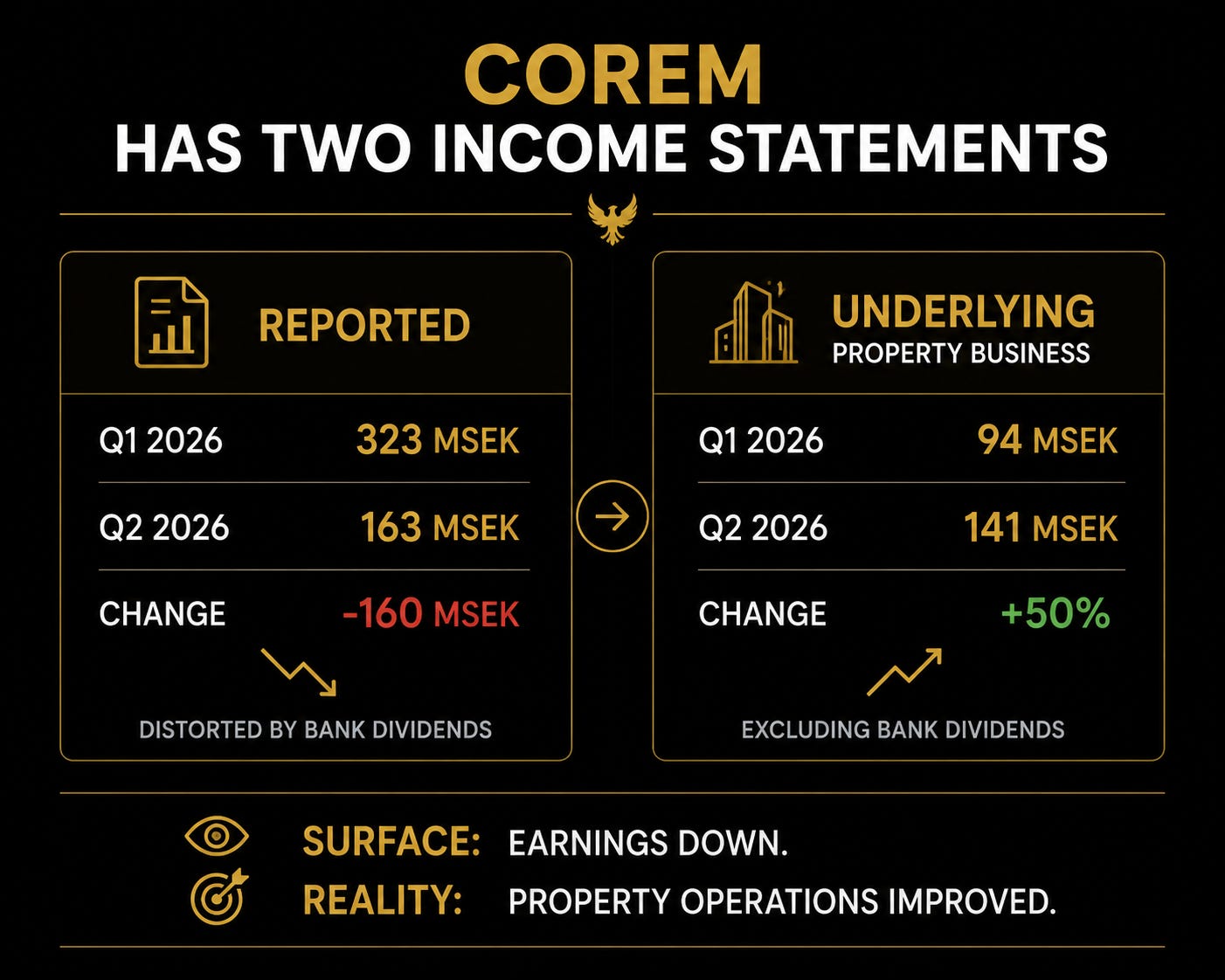
Q1 looked stronger than it really was. Q2 looked weaker than it really was. Adjusting for bank dividends changes the story entirely.

Absolut. Här är en version utan tabeller som fungerar mycket bättre att klistra in i Substack:
Corem Has Two Income Statements
Q1 looked stronger than it really was. Q2 looked weaker than it really was. Adjusting for bank dividends changes the story entirely.
Corem’s Q2 report contains an interesting paradox.
Property management income fell from SEK 323 million in Q1 to SEK 163 million in Q2.
Anyone stopping there sees a company whose earnings power almost halved within a single quarter.
Anyone digging deeper sees something very different.
The Bank Portfolio Changes the Picture
The difference is not primarily explained by the property business.
It is explained by bank dividends.
During Q1, Corem received SEK 229 million in dividends from its Nordic bank holdings.
In Q2, the corresponding figure was only SEK 22 million.
This is not unusual.
Nordic banks typically pay the majority of their dividends during the spring, causing income to be concentrated in Q1 regardless of how the underlying property portfolio performs.
Meanwhile, financing costs were virtually unchanged:
Q1: SEK 347 million
Q2: SEK 349 million
Adjusting for the bank dividends paints a very different picture:
Reported Property Management Income
Q1 2026: SEK 323 million
Q2 2026: SEK 163 million
Change: -SEK 160 million
Bank Dividends
Q1 2026: SEK 229 million
Q2 2026: SEK 22 million
Underlying Property Business
Q1 2026: SEK 94 million
Q2 2026: SEK 141 million
Change: +SEK 47 million (+50%)
On the surface: deterioration.
Under the surface: significant improvement.
The Portfolio Cleanup Is Working
What makes the report even more interesting is the development in operating surplus.
Rental Income
Q1 2026: SEK 799 million
Q2 2026: SEK 787 million
Change: -SEK 12 million
Property Costs
Q1 2026: -SEK 325 million
Q2 2026: -SEK 265 million
Change: +SEK 60 million
Operating Surplus
Q1 2026: SEK 474 million
Q2 2026: SEK 522 million
Change: +SEK 48 million
Operating surplus increased despite the portfolio becoming smaller.
That is not what one would normally expect after asset sales.
Several factors help explain the improvement.
First, portfolio quality improved.
Assets disposed of during the first half of the year contributed relatively little earnings. One example was 417 Park Avenue in New York, a land asset producing virtually no rental income while still carrying financing and administrative costs.
Selling such assets improves the quality of the remaining portfolio even if the overall property portfolio shrinks.
Second, seasonality played a role.
Q1 was affected by unusually high winter-related costs, including heating and snow removal expenses. Property costs fell materially in Q2 as weather conditions normalized.
Third, the like-for-like portfolio remained stable.
Corem reported that income from comparable properties increased by approximately 1% during the first half of the year, while like-for-like net operating income remained unchanged.
That is not impressive.
But it is stable.
And stability is preferable to deterioration.
Two Businesses Inside One Company
This raises a broader question.
What exactly is Corem today?
At quarter-end, the market value of Corem’s bank holdings amounted to approximately SEK 2.8 billion.
In addition, Corem owns approximately 8% of Klövern, valued at roughly SEK 755 million.
Combined, the financial investment portfolio represents approximately SEK 3.6 billion of assets.
Corem remains, at its core, a property company.
But the financial portfolio has become large enough to materially influence reported earnings.
As a result, quarterly comparisons can easily become misleading.
The reported property management result no longer reflects only the performance of the real estate portfolio.
It also reflects the timing of dividend flows from financial investments.
Investors therefore need to separate the two businesses before drawing conclusions.
Most probably do not.
The Risk Profile Has Not Changed
None of this means Corem’s challenges have disappeared.
Interest-bearing net debt remains SEK 25.6 billion.
Loan-to-value remains 56%.
Interest coverage remains 1.7x.
Net leasing for the first half of 2026 was still negative SEK 3 million.
Kista remains the most important structural question.
Ericsson’s leases account for a meaningful portion of the area’s value and have approximately four years remaining.
Four years is manageable.
It is not ten.
The financial portfolio does not solve any of these underlying challenges.
The Question That Matters
Q1 looked stronger than operational performance justified.
Q2 looked weaker than operational performance justified.
The reason is the same in both cases:
The timing of bank dividends.
For me, it is therefore the wrong question to ask how much the bank portfolio will distribute next year.
The more important question is whether the underlying property business can continue improving.
Q1 generated SEK 94 million.
Q2 generated SEK 141 million.
If that trajectory continues, Corem gradually becomes a property story again.
If it stalls, the bank portfolio will continue to dominate the earnings discussion.
And that is a crucial distinction.
Because ultimately, valuation will depend not on the size of the dividend portfolio, but on whether the underlying property business can once again stand on its own.